
AI needs an ethical compass and young people to help hold it
Paola Gálvez Callirgos, Globethics AI Ethics Manager, September 2026.
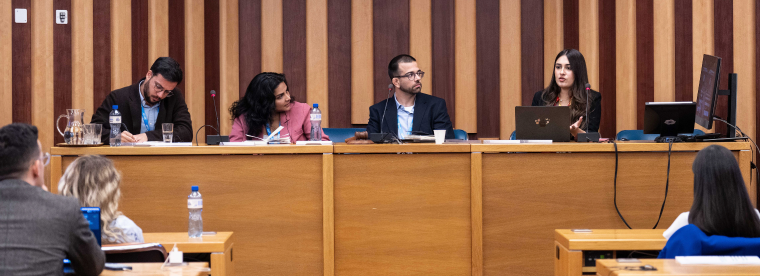
This week, world leaders gather in New York for the 81st UN General Assembly. AI is high on the agenda, after several weeks of apocalyptic warnings about the technology. Beyond the hype and anxiety, the exchanges I had last week at UNESCO's 4th Global Forum on the Ethics of AI (GFEAI) left me with one clear conviction: if AI governance is to deliver for all, it must start from the harms already here, be steered by an ethical compass grounded in human rights, and be shaped with the young people and civil society who live closest to its impact.
The fear of machines outsmarting us is not new. Back in 2017, Facebook researchers reported that their dialogue agents had developed a tactic they were never programmed to use, but that helped them achieve their goals. Almost a decade later, headlines echo that concern, now framed as a debate about AI slipping beyond human control. That debate deserves attention; however, it should not crowd out the harms we can already observe and act on today.
One of them worries me in particular: knowledge decay and the decline of critical thinking. Every time we hand over a judgment we could have exercised ourselves, we trade a little of our capacity to think for a little convenience. Over time, the skills we stop practising start to fade, and critical thinking is the first to go. For young people who are still building those skills, the stakes are highest. At the UN Global Dialogue on AI Governance in July, participants noted children's rapidly growing use of AI tools for schoolwork and emotional support, while safety guidelines have yet to keep pace.
This week, the Director General of UNESCO and the Secretary General of ITU captured this in their joint statement Who Gets to Shape AI's Future?. As investment in computing power accelerates, "we must invest in human intelligence with the same urgency and determination." Protecting our capacity to think, question, and judge is not a side issue of AI governance; it is at its core.
Civil society is often the first to notice when that capacity, or any other right, is being eroded. The Global Dialogue’s summary recognised that some AI harms remain undercounted in scientific literature, even where civil society has documented them well. Good governance needs both: the evidence of science and the experience of the communities affected.
The good news is that we do not need to invent a compass. We already have one. The UNESCO Recommendation on the Ethics of AI, adopted by 193 Member States, and international human rights law give us a universally agreed point of departure. Beyond principles, both frameworks set out clear actions: assessing the impact of a system on people's rights before it is deployed, keeping humans in charge of decisions that affect lives, and ensuring that anyone harmed can seek redress. What we need now is to put them into practice, with the people most affected by AI taking part.
Today, those people are still missing from the table. The Global Dialogue, which received 1,532 written submissions, flagged the underrepresentation of youth, civil society, and women. Yet, at the GFEAI, the hundreds of young students who attended and took part in the sessions showed me that the will is there. What is missing is capacity.
At Globethics, we see what changes when that capacity is built. Through the Empowering CSOs to Lead the Way in Advancing AI Ethics course developed in support of UNESCO, 30 civil society organisations gained the tools to engage critically with AI, and our Emerging Leaders in Ethical AI Governance Fellowship brings together 14 fellows from all over the world, who made their voices heard at AI for Good, the UN's leading global platform on AI, while developing their own projects under the mentorship of senior experts. When a civil society organisation knows how to read an impact assessment, it moves from reacting to harms to preventing them. When a young leader understands how standards are set, they are no longer just governed by the rules, but instead start shaping them.
So what can leaders in New York do this week? I see three practical steps. First, put present harms on the agenda alongside long term risks. Second, make human rights impact assessment a condition of AI deployment in your nations and organisations. Third, fund capacity development and seats at the table for youth and civil society. The co-chairs of the Global Dialogue recorded that their process relied largely on goodwill and voluntary effort, and called for timely support with funding and visas for those who cannot afford to attend. Looking ahead to the 2nd Global Dialogue on AI Governance and the Geneva AI Summit, let’s remember that inclusion is not a courtesy we extend to others, but the condition for getting AI governance right.